Topics at the Allianz Center for Technology:
64th Traffic Court Conference (“Deutscher Verkehrsgerichtstag, VGT”)
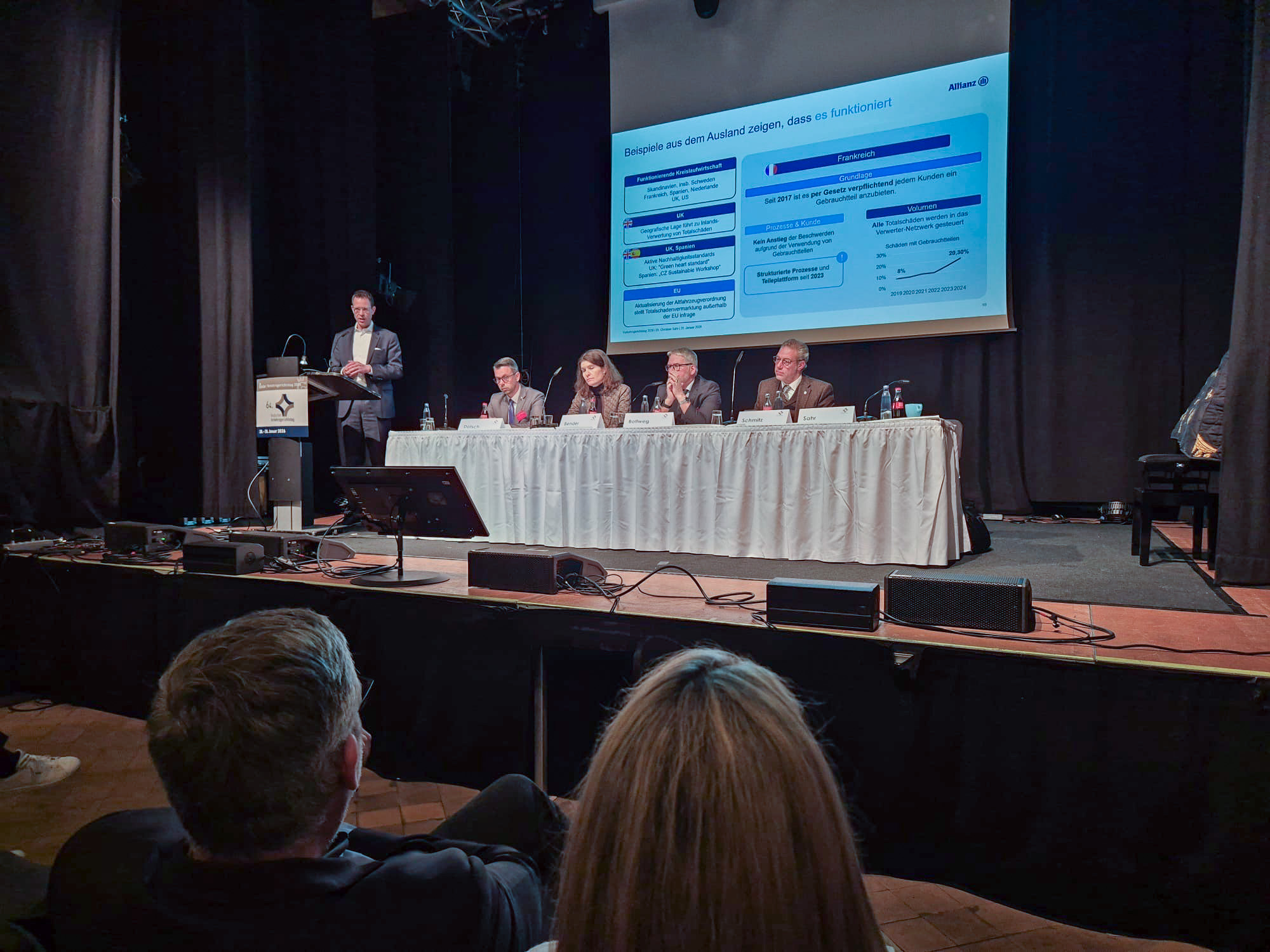
At the 64th Traffic Court Conference in Goslar (VGT), various working groups discussed topics that are also highly relevant to AZT and Allianz and on which we have been working hard for some time.
February 2026
The recommendations published by the VGT working groups show that we are not alone and that several industries are actively working together to achieve progress in certain areas.
We have taken note of some of the VGT's findings with particular interest and would like to add our perspective.
Distraction in road traffic: the 64th VGT confirms AZT findings
The working group to accident risk due to distraction by cell phones and others has taken up a topic that the AZT has been scientifically investigating for many years. The working group's discussions and recommendations confirm the key findings of our earlier studies.
Key statements from the working group
The discussions focused on the increasing distraction caused by modern technology, in particular smartphones, infotainment systems, and complex operating concepts in vehicles. The Traffic Court Conference made it clear that:
distraction is a key and still underestimated cause of accidents.
brief distractions of the gaze and attention are enough to significantly increase the risk of accidents.
in addition to clear legal requirements, consistent education, training, and prevention are needed to bring about lasting change in risky behavior.
technology must not place an additional burden on drivers, but must be intuitive, fault-tolerant, and safety-oriented.
distraction has not yet been adequately reflected in accident statistics. The Traffic Court Conference therefore expressly advocates strengthening research into unreported cases in order to better capture the actual extent of distraction-related accidents.
This puts distraction back on a par with other established risk factors such as alcohol or excessive speed.
AZT position: Distraction is not a marginal phenomenon
From the AZT's point of view, these assessments are logical. Allianz studies conducted in recent years have consistently shown that:
distraction massively increases the risk of accidents – by 40 to over 50 percent, depending on the activity. Texting, prolonged distractions, and complex touchscreen operations are particularly critical. [1]
Many drivers are unaware of the legal limits or significantly underestimate them, for example, with regard to the permissible duration of looking away from the road or the use of driver assistance systems.[2]
Distraction is not limited to digital media: eating, drinking, conversations, emotional situations, or passengers also have a measurable impact on driving performance.
Young drivers are particularly at risk because they use distractions more frequently and underestimate risks.
The AZT pointed out early on that distraction must be systematically taken into account in accident statistics and taken seriously as an independent risk factor—a demand that has now also been incorporated into official accident reports.
Joint conclusion
The findings of the 2026 Traffic Court Conference underscore that
distraction is not the result of individual misconduct, but rather a structural challenge of modern mobility. From the AZT's perspective, this requires a combination of:
comprehensible and enforceable rules,
targeted road safety work,
realistic driver education,
and user-centered, safety-oriented vehicle and HMI design.
The Traffic Court Conference thus provides important impetus for further focusing the issue of distraction in the areas of law, technology, and prevention – in line with the long-standing scientific findings of AZT.
Outlook
The results of the 2026 Traffic Court Conference make it clear that distraction in road traffic will remain a key challenge for road safety in the future. Against this backdrop, AZT will continue to focus on this topic in its work and actively monitor relevant developments through its own research and analysis.
The aim is to thoroughly evaluate the effects of distraction and provide effective impetus for prevention, vehicle design, and road safety.
[1] Gefährliche Alleskönner: Moderne Technik lenkt Fahrer zu stark ab. Allianz press release dated March 1, 2023.
[2] Klare Verbote, hohe Bußgelder – doch kaum einer kennt die Regeln. Allianz press release dated May 9, 2023.
Accident data: Fewer accident victims thanks to research based on better data
In order to sustainably reduce the number of traffic accident victims, meaningful statistics on the causes, locations, and consequences of accidents are essential. Standardized, high-quality accident reporting by the police is to be welcomed, as it ensures data protection while still allowing research and development access to reliable official data.
Particular attention should be paid to accidents involving serious injuries and fatalities in order to fully exploit the potential for accident prevention. However, it is precisely here that the statistics are unclear and international comparison is often not possible. The term “seriously injured” is too broad. Accident victims who were admitted to hospital for 24 hours, often only for observation, should be recorded separately from accident victims who require longer hospital treatment, suffer long-term consequences, or even die after more than 30 days. At the Traffic Court Conference, it was therefore recommended, among other things, that the subcategory “potentially life-threatening injury” be included in the official traffic accident statistics as a consequence of an accident, in accordance with the international standard Maximum Abbreviated Injury Scale (MAIS3+), instead of the previous category “seriously injured.”
Data-based accident research and the derivation of measures to promote Vision Zero are central tasks of the AZT. We therefore consider the recommendations of the Traffic Court Conference to be effective.
We will address the topic of repairing accident damage with used parts, which is very important to the AZT and Allianz and was also discussed in a working group at the Traffic Court Conference, in a separate article.
The recommendations of all working groups can be found on the Traffic Court Conference website: deutscher-verkehrsgerichtstag - Current recommendation


